

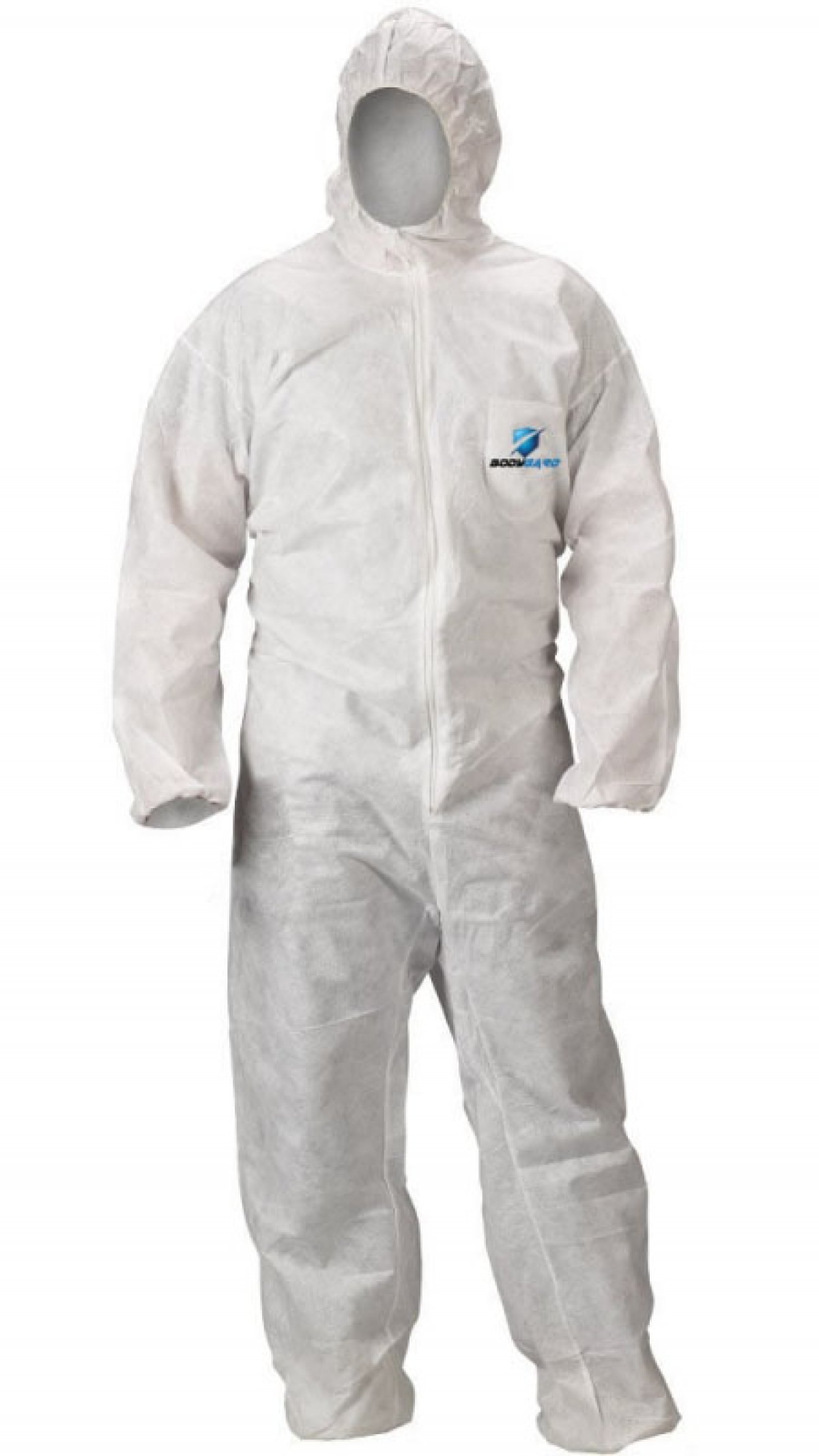
A disposable coverall that is too light leaves workers exposed. One that is heavier than the job needs costs more and makes long shifts harder. The right choice comes down to three things: the hazard, the protection rating and the fit. This guide explains how coverall ratings work, what Type 5 and Type 6 mean, and what to check when you buy coveralls by the case. It uses the Bodygard FLX range as examples.
Start with the hazard
Before comparing products, write down what the coverall has to keep out:
- Dry particles. Dust, fibers, powders, and asbestos or lead during removal work.
- Liquids. Light splash or mist, heavier spray, or pressurized jets. Is the liquid water-based, paint, or a chemical? If chemical, which one?
- Biological agents. Infective material, for example during cleaning or veterinary work.
- Other factors. Static-sensitive or flammable atmospheres, heat stress, contamination of the product itself (food or pharma), or visibility.
In the US, OSHA expects employers to assess workplace hazards and select PPE to match (29 CFR 1910.132). Your safety lead or the chemical's safety data sheet should drive the final choice. This guide helps you read the ratings.
Categories and Types: how coveralls are rated
Most disposable coveralls, including Bodygard FLX, are rated to European standards. Two systems are used.
PPE categories. Category I covers simple products for minimal risks. Category II is intermediate. Category III covers complex PPE that protects against hazards that could be life-threatening. Category III coveralls need EU type-examination by a notified body.
Chemical protective clothing Types. These run from 1 (most protective) to 6:
| Type | Standard | Protects against |
|---|---|---|
| Type 1 | EN 943-1 | Gas-tight suits, sealed against the environment |
| Type 2 | EN 943-1 | Non-gas-tight suits that hold positive internal pressure |
| Type 3 | EN 14605 | Liquid-tight: strong, directional jets of liquid chemical |
| Type 4 | EN 14605 | Spray-tight: saturating liquid spray that pools and runs |
| Type 5 | EN ISO 13982-1 | Hazardous dry particles |
| Type 6 | EN 13034 | Light spray and splashes, no directional jet or liquid build-up |
Additional marks you may see:
- EN 1149-5. Electrostatic dissipative clothing, for areas where static could ignite vapors or dust.
- EN 1073-2. Protection against particulate radioactive contamination.
- EN 14126. Protection against biological hazards and infective agents.
Type 5/6: the workhorse rating
A Type 5/6 coverall combines particle tightness with limited splash protection. It suits much industrial work: spray painting, insulation and asbestos removal, grinding and polishing, pesticide application, pharmaceutical powders and general maintenance. It is not meant for pressurized jets or heavy, saturating liquid exposure. Those need Type 3 or Type 4 garments with sealed seams.
Type 5/6 does not tell you which chemicals a fabric resists, either. For chemical work, ask for chemical permeation or penetration data for your specific substances.
Fabric: what is it made of?
Disposable coveralls usually use one of two constructions:
- Polypropylene spunbond or SMS nonwoven. Light, breathable and economical. Good for keeping clothes clean and for non-hazardous dust and light, non-toxic splash.
- Microporous film laminate. A breathable film bonded to a nonwoven. It blocks fine particles and liquid splash and still lets moisture vapor out. This is the usual fabric for Type 5/6 coveralls.
Weight matters, but it is not a rating. A heavier fabric is not automatically more protective, so check the certification, not the g/m2.
Design details that matter on the job
- Hood. Should fit snugly around a respirator or full-face mask.
- Zipper and flap. A storm flap (ideally self-adhesive) over the zipper stops particles and splash getting in through the closure.
- Elastic at the face, wrists, waist and ankles keeps contaminants out and keeps the suit in place.
- Thumb loops stop sleeves riding up when the worker reaches overhead.
- Reinforced crotch and a good cut help prevent seam failure when kneeling or climbing.
- Breathable panels. A breathable back panel reduces heat stress on long or warm shifts.
The Bodygard FLX range at a glance
| Model | Fabric (per site) | Rating (per site) | Typical use |
|---|---|---|---|
| FLX 2000 | Microporous laminate, 55-58 g/m2, white | Category III, Type 5/6; EN 14126; antistatic tested to EN 1149-5 | Spray painting, asbestos work, toxic powders, pesticide spraying |
The FLX 2000 is supplied with an EU Declaration of Conformity under Regulation (EU) 2016/425. It references EN ISO 13982-1 (Type 5), EN 13034 (Type 6), EN 14126 and ISO 13688, and EU type-examination by notified body 0624. None of the FLX coveralls are medical devices, and none are FDA 510(k) cleared.
Getting the size right
An undersized coverall tears at the crotch and shoulders. An oversized one snags and lets particles in at the cuffs. Bodygard coveralls follow the size chart below (EN 340 sizing, per the size table):
| Size | Chest (cm) | Height (cm) |
|---|---|---|
| S | 84-92 | 162-170 |
| M | 92-100 | 170-176 |
| L | 100-108 | 176-182 |
| XL | 108-116 | 182-188 |
| 2XL | 116-124 | 188-194 |
| 3XL | Special oversize | Special oversize |
Buying coveralls in bulk: a checklist
- Match the rating to the task, not to the price. Use Type 5/6 where the hazard calls for it and lighter coveralls everywhere else.
- Ask for the paperwork. You need the Declaration of Conformity, the EU type-examination certificate (for Category III) and any test reports. Bodygard documents are on our Certificates page.
- Plan the size mix from your headcount, using the chart above.
- Check packaging. Individually bagged coveralls are easier to hand out and keep clean, and bulk packs take less space. The FLX 500 and FLX 1000 come either way.
- Trial before you switch. Have your crew wear samples for a full shift to test comfort, hood fit with respirators, and durability.
Request pricing or samples
Bodyguard Advanced Materials LLC supplies Bodygard FLX disposable coveralls to US industrial buyers and distributors from Miami, FL. Compare models on the disposable coveralls page, read more about coverall standards, or email sales@bodyguardus.com or call +1 (201) 881-2055 for a bulk quote.
22 October 2026

